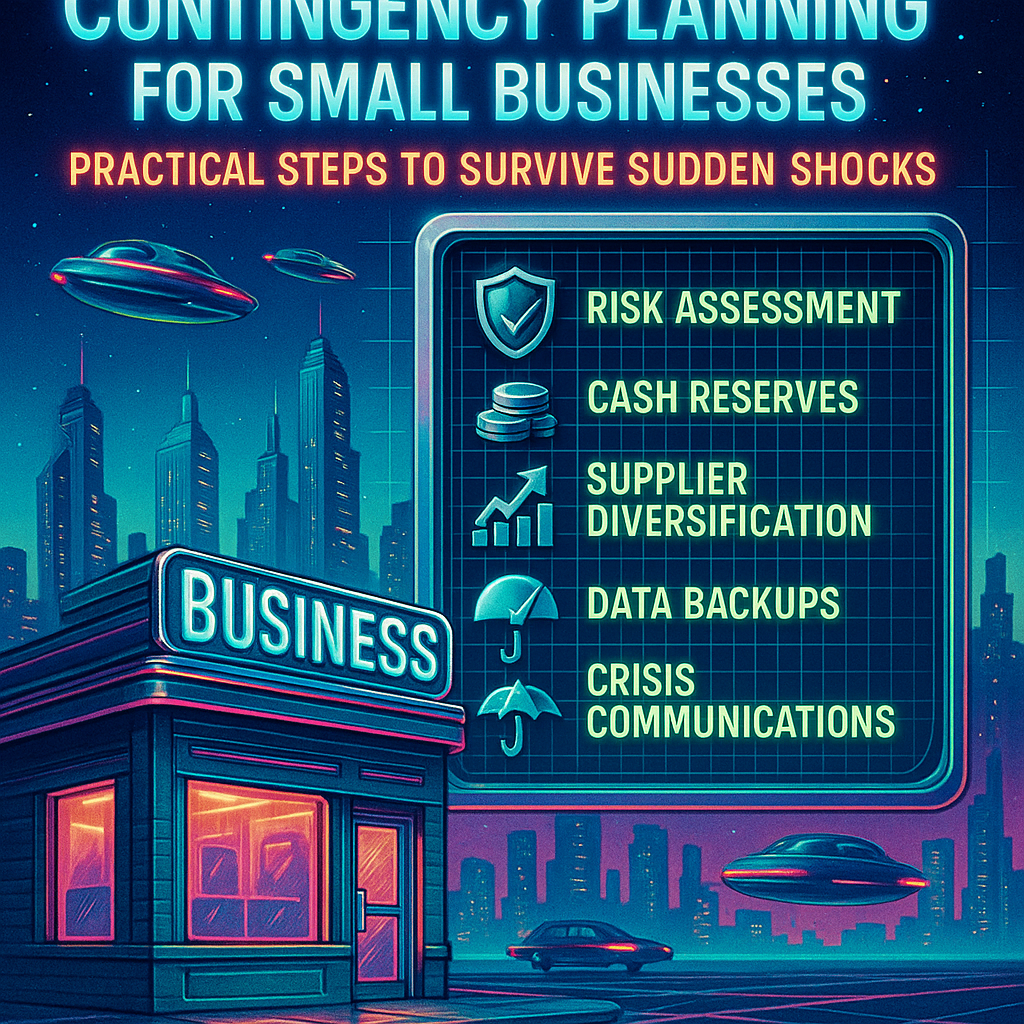
A delivery route disappears overnight, a key vendor stops answering, and payroll is due Friday. Contingency planning for small businesses matters because the shocks arrive without warning and take down unprepared operators.
I learned this the hard way running a service business that relied on a single supplier. One regulatory change and a supplier shortfall forced us to restructure staffing, renegotiate leases, and rebuild client trust in six weeks. That scramble taught me clear, repeatable rules that any owner can use to avoid being reactive and exposed.
Why contingency planning for small businesses is not optional
Small companies hold little buffer. A two-week revenue drop can cascade into missed supplier payments and layoffs. Owners who treat contingency planning as a one-time checklist miss the real point. A plan must be living, tied to measurable triggers, and embedded in daily operations.
When you plan properly, you shorten response time, protect margins, and keep customers calm. That yields survival and a competitive advantage when your competitors are scrambling.
Build a practical contingency playbook with three parts
Start with a one-page playbook that every manager can read in two minutes. The playbook splits into three parts: triggers, immediate actions, and authority.
Triggers are simple, objective signals. Examples: cash on hand drops below four weeks of payroll, a vendor fails to deliver two shipments, or more than 10 percent of frontline staff call out within 72 hours. Use numbers, not feelings.
Immediate actions are short, prioritized steps tied to each trigger. For a vendor failure, actions might be: 1) activate backup vendor list, 2) move affected clients to alternate products, 3) notify customers with timing expectations. Keep each action limited and time-bound.
Authority lists who makes which decision in the first 48 hours. Clarify who approves emergency spend, who communicates externally, and who manages HR moves. Avoid committee decision-making in the first 72 hours.
Secure at least a six-week cash runway and a simple liquidity plan
Most small businesses underestimate the speed of cash shortfalls. Calculate your core cash burn — payroll, rent, essential vendor payments — and maintain a target buffer of six weeks.
If holding six weeks of cash is impossible, build a liquidity plan. That plan should include a prioritized list of temporary cost reductions, short-term credit options with contact names, and a one-line explanation of the paperwork required. Know exactly how long each option takes to draw (for example, three business days for a local bank overdraft vs two weeks for a new line of credit).
When considering reductions, rank cuts by impact on revenue generation, not just by immediate dollar value. Cutting a salesperson who generates new accounts will harm recovery.
Cross-train, document, and create quick-play substitutes
Key-person risk kills small operations. Pick your three most critical roles and document the one-hour recovery steps for each. Train at least one backup who can execute those steps under pressure.
Create quick-play substitutes for critical inputs. Maintain a vetted list of two alternate vendors per critical item, with contact information, typical lead times, and recent pricing. Test those relationships once a quarter with a small, inexpensive order.
Simple documentation prevents paralysis. Store recovery steps and vendor lists where any manager can access them without asking for permission.
Run fast scenarios and after-action reviews
Plan tabletop drills twice a year. Use one realistic local scenario and run a 60-minute exercise with leadership. Focus on decision speed, communication clarity, and whether the triggers would have fired.
After the drill, do a blunt after-action review. Capture three things that worked, three things that failed, and one change you will implement before the next drill. Make the fixes visible and assign owners.
Real incidents will reveal different gaps than drills. After a real event, run the same short after-action review within two weeks and update the playbook.
Communicate early and honestly with customers and staff
When disruption arrives, information is your most precious currency. Tell customers what you know, what you don’t know, and what you will do next. Give concrete timelines and avoid speculative promises.
For staff, explain the facts, the options you are exploring, and the near-term actions they can expect. That reduces rumor, keeps people focused, and preserves morale.
Good external communications follow a simple formula: problem, impact, next steps, and where to get updates. Keep updates frequent and short.
Strengthen decisions with steady principles
In the chaos of a shock, leaders fall back on principles. A few I use: protect cash, preserve customer-facing capacity, and keep core team members informed. These priorities help you choose between painful options and avoid paralysis.
Develop a short set of decision rules and post them on the playbook. For example: if cash falls below three weeks, freeze nonessential hires; if a vendor misses two deliveries, shift to alternate supplier immediately.
These rules speed action and reduce second-guessing during stressful moments. They also create accountability because the team can see why choices were made.
Where leadership matters most
Contingency plans are technical, but their success depends on human behavior. Leaders set the tone. Calm, decisive communication and visible presence reduce panic and keep execution tight.
If you want a concise primer on building leadership habits that support rapid response, study short essays on practical leadership. The right leader does not have to be charismatic. They must be predictable, available, and decisive.
Closing insight: plan for the next unexpected, not the last one
Owners often build plans around the last crisis. That creates blind spots. Instead, build flexible systems that work for multiple failure modes. Short, testable playbooks, clear triggers, a six-week liquidity mindset, and routine drills create resilience.
You will not stop every setback. But you will shorten the time to recover, protect your team, and keep customers. That practical advantage separates businesses that limp along from those that survive and reemerge stronger.
If you can carve out two hours this month, write a one-page playbook, name the triggers, and call two backup vendors. Those small steps deliver outsized returns when the next shock arrives.
Leave a Reply