Roanoke
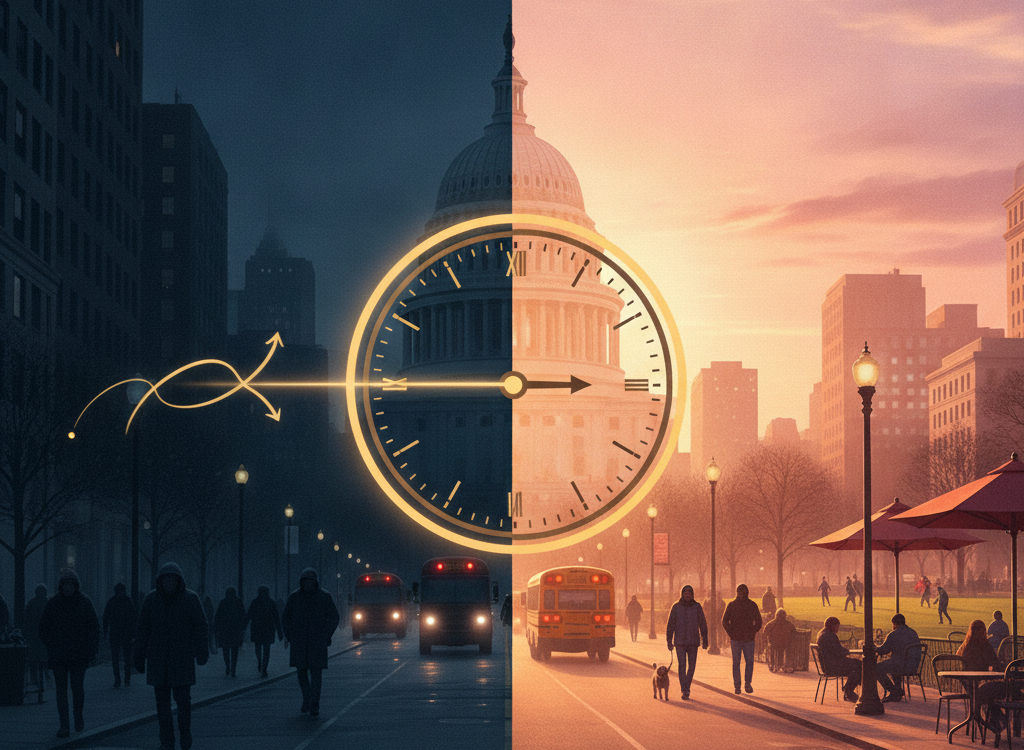
On July 14, 2026, the U.S. House of Representatives passed the Sunshine Protection Act, H.R. 139, by a vote of 308-117, moving a long-running debate over the nation’s clocks one step closer to a possible overhaul. The bill would make daylight saving time permanent year-round, ending the twice-yearly switch between standard time and daylight saving time. For East Coast residents, the proposal could mean brighter winter evenings — and darker winter mornings.
The measure now goes to the Senate, where its future remains uncertain. It also preserves an important detail that could shape how the policy is applied: states would retain the option to opt out.
What The Bill Would Change
Under the current system, most of the United States moves clocks forward one hour in the spring and back one hour in the fall. That means daylight saving time gives people lighter evenings for part of the year, but standard time returns in the colder months, shifting sunrise and sunset earlier.
The Sunshine Protection Act would stop the fall rollback entirely. If enacted, the country would remain on daylight saving time all year, effectively keeping clocks one hour ahead of the current standard-time baseline even in winter.
Supporters say that would remove confusion, reduce the twice-yearly disruption to routines, and give people more usable light after work or school. Critics counter that the tradeoff is not just symbolic. It would move winter daylight away from the morning, when many people are commuting, starting classes, or beginning work.
The impact would be felt differently depending on geography. The farther north a place sits within the Eastern Time zone, the more dramatic the change would appear in winter. That is why the debate has special relevance in places such as New York, Boston, and Washington, D.C.
East Coast Winters Under Permanent DST
For much of the East Coast, permanent daylight saving time would push sunset later into the afternoon and evening, but it would also delay sunrise by an hour compared with the current winter schedule.
In New York City, for example, a December sunset that currently arrives around 4:30 p.m. would shift to roughly 5:30 p.m. under permanent DST. That extra hour of light after work could change how New Yorkers plan errands, exercise, and family time. But sunrise would also move later, meaning morning commuters would begin the day in darker conditions.
Boston would see an even sharper effect because it sits farther north. Winter mornings there are already dark, and under permanent DST, daylight would arrive later still. Washington, D.C., would also experience darker mornings, though the effect would be somewhat less severe than in New England. The change would be felt across the region, but the burden would not be identical from city to city.
Florida, meanwhile, complicates the picture. Parts of the state already experience relatively early sunrise and sunset patterns compared with the Northeast, and supporters of permanent DST often point to the appeal of longer evening light in warm-weather states. For residents who work outside or spend afternoons at parks, beaches, or sporting events, the extra daylight after 5 p.m. may be welcomed.
The result is a policy that looks appealing to some families and businesses while raising practical concerns for others. In East Coast cities, permanent DST would not simply add daylight; it would redistribute it.
Arguments In Favor Of Permanent DST
Proponents say the biggest advantage is simple: more light in the evening, when people are most likely to be active.
That could help restaurants, retail stores, parks, and recreational businesses by encouraging people to stay out later. It may also support outdoor exercise, youth sports, and after-school activities, all of which become harder to schedule when sunset comes early. For households, an extra hour of light after the workday can mean more time with children, a more flexible commute home, or fewer errands done in the dark.
Some supporters also argue that darker evening streets are associated with a greater sense of vulnerability, especially for pedestrians and drivers navigating rush-hour traffic in winter. While the safety effects are debated, the perception of improved evening visibility is one of the proposal’s strongest selling points.
Backers also frame the measure as a simplification. Instead of switching clocks twice a year, the country would settle into one year-round system. That appeal has helped keep the issue alive in Congress for years, even as previous efforts stalled.
The bill’s backing from former President Donald Trump gives the proposal added political visibility. While that support does not guarantee Senate passage, it signals that permanent daylight saving time remains a live issue within national politics.
Concerns About Darker Mornings And Health
Opponents focus on the morning side of the ledger. If sunset moves later in winter, sunrise must move later too. For many East Coast residents, that means children heading to school and adults commuting to work would do so in deeper darkness.
That concern is especially pronounced in northern areas such as Boston and parts of the Northeast, where winter daylight is already limited. School buses, walking routes, and crowded urban transit systems would all operate under darker conditions. Parents and local officials could face fresh questions about safety, visibility, and schedule changes.
There are also health arguments against permanent daylight saving time. Sleep researchers and circadian-health experts have long said that morning light plays an important role in setting the body’s internal clock. Delaying sunrise could make it harder for some people to wake up, feel alert early in the day, or maintain regular sleep patterns.
Those concerns are not limited to a small subset of the population. Children, teenagers, shift workers, and people with early-start jobs may be especially affected by a permanent one-hour shift later in the morning. In that sense, the debate is not only about convenience, but about how well a national time policy aligns with human biology and daily routines.
Opponents also note that winter mornings matter most when the season is cold, dark, and often stressful already. A later sunrise may not sound like a major change on paper, but in January it could mean leaving for work or school before daylight appears.
What Happens Next In The Senate
The House vote is a major development, but not the end of the process. The bill now moves to the Senate, where support has historically been harder to assemble for time-change legislation.
If the Senate takes up the measure, lawmakers will likely revisit the same questions that have defined the debate for years: whether more evening daylight is worth darker mornings, whether the country should adopt one national time standard, and whether states should have flexibility to choose differently.
That state opt-out provision could prove significant. It creates the possibility of a patchwork system in which some states remain on standard time while others adopt permanent daylight saving time. Supporters see that as a compromise; critics may see it as a source of confusion if neighboring states end up on different schedules.
For East Coast residents, the Senate debate will determine whether the change becomes a national reality or remains another near miss. The region stands to gain longer evenings, but it would also absorb some of the country’s most noticeable winter-morning shifts.
For now, the House vote has revived a question that has followed Americans for decades: should the nation keep daylight longer into the evening, even if that means starting winter mornings in the dark? The answer may depend less on ideology than on which hour of the day people value most.