Roanoke
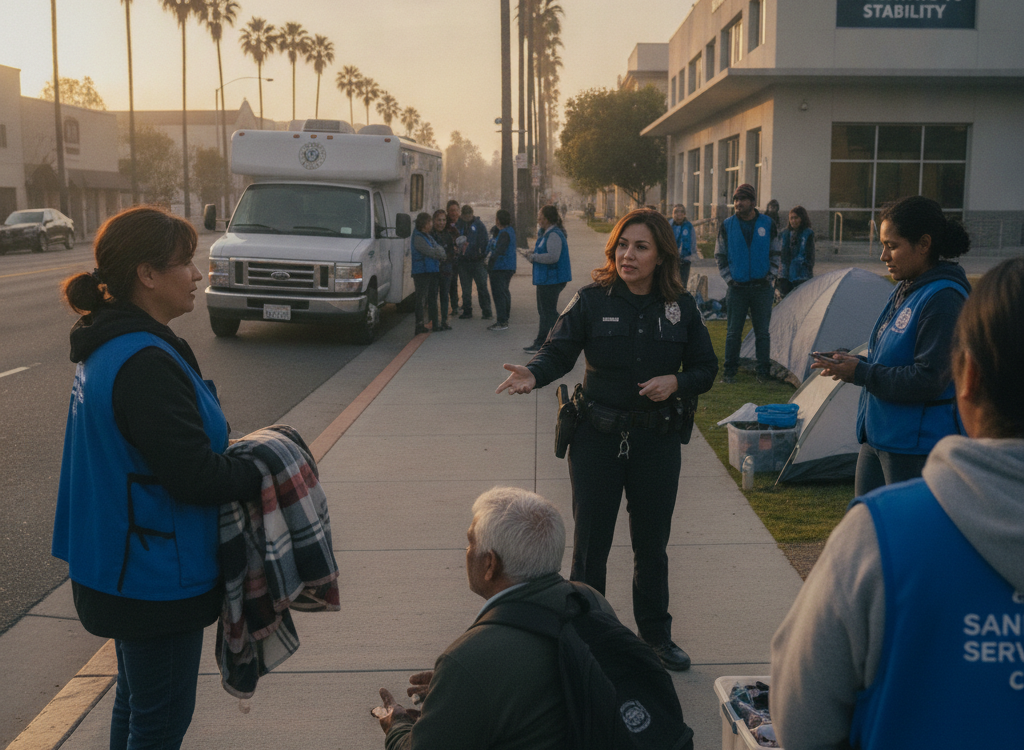
Santa Ana is seeing early signs that a coordinated, help-first approach backed by clear enforcement can reduce street homelessness without abandoning public order. Under Mayor Valerie Amezcua, the city has leaned into monthly outreach operations that bring shelter, detox, addiction treatment, and family reunification services directly to people living outdoors — and pair those offers with citations or jail when help is repeatedly refused.
The result, city officials say, is a model that is more practical than ideological: give people real pathways off the street, but do not allow encampments to become permanent when assistance is available and declined. That posture has coincided with a reported decline in unsheltered homelessness, from 871 in the 2024 point-in-time count toward the mid-700s more recently, a shift that stands out at a time when many cities continue to struggle with visible street homelessness.
Monthly Outreach That Connects People To Real Options
Santa Ana’s approach centers on recurring, coordinated outreach operations rather than one-off sweeps. Those efforts bring together city staff, outreach workers, and service providers to engage people where they are, assess immediate needs, and offer concrete alternatives to sleeping outdoors.
The services offered are designed to meet the most common barriers that keep people on the street. For some, that means a shelter bed. For others, it means detox placement, addiction treatment, or help reconnecting with family members who can provide a stable place to recover.
That structure matters because many street-level interventions fail when they stop at displacement. Santa Ana’s model is built around the premise that outreach is more effective when it is repeated, organized, and connected to specific outcomes rather than to a generic referral sheet.
In practice, that means monthly operations can move people out of camps and into a pathway that addresses the causes of their homelessness. The city’s emphasis on services first is not only about compassion; it is also about creating a process that can be measured.
Help Is Offered First, But Refusal Has Consequences
The second half of Santa Ana’s strategy is just as important as the first. When people refuse available help, the city enforces anti-camping and other public-order rules, a position supported by Orange County’s anti-camping ordinance.
Mayor Amezcua has framed the policy in plain terms: leaving people on the streets is not compassion. Her message has been that residents deserve clean, safe neighborhoods, parks, and streets — and that public spaces should not become long-term encampments simply because doing nothing feels easier.
That combination of outreach and enforcement is increasingly common among cities that have concluded that service offers alone are not enough. The logic is straightforward. If help is available and repeatedly declined, the city still has a responsibility to protect public spaces and to avoid allowing dangerous or unsanitary conditions to persist indefinitely.
Santa Ana’s approach does not treat enforcement as a substitute for services. Rather, it treats enforcement as the mechanism that keeps the system credible. Residents see that the city is making a genuine offer of assistance, while unhoused individuals who want help have a clearer route to accept it.
Early Outcomes Show Movement In The Right Direction
The clearest indication that the approach is working is the reported decline in unsheltered homelessness. A drop from 871 in the 2024 point-in-time count to figures in the mid-700s more recently suggests that more people are getting connected to shelter or other forms of assistance, even if the problem remains substantial.
Just as important are the results of recent outreach operations. According to the city’s reported outcomes, some people have accepted shelter, detox, treatment, or family reunification support when approached. Others have declined assistance and faced citations or jail for violating anti-camping and public-order rules.
Those different outcomes underscore the central point of the policy. The city is not assuming that every person living on the street is immediately ready to enter treatment or shelter. But it is making clear that refusal is not consequence-free.
For residents, the practical effect is visible in parks, sidewalks, and business districts where persistent encampments can create sanitation problems, block access, and increase fear. For unhoused people willing to accept services, the city’s approach can be the first step toward stability rather than another encounter that ends with a tent being moved and the cycle beginning again.
Why The Model Is Getting Attention
Santa Ana’s strategy also fits a broader shift in homelessness policy across California and beyond. More local governments are moving toward recovery-oriented models that combine compassion with accountability, especially as the limits of permissive approaches have become harder to ignore.
By contrast, cities that have relied primarily on toleration, repeated outreach without enforcement, or broad reluctance to clear camps have often struggled to show measurable reductions in unsheltered homelessness. The difference is not philosophical so much as operational: when there are no consequences for refusing available help, outreach can lose urgency and encampments can become entrenched.
Santa Ana’s early results make the city noteworthy because they suggest a middle path that is both humane and enforceable. People in crisis are offered tangible support, but the city also insists that public spaces remain usable and safe for the broader community.
That balance is not simple to maintain. It requires enough shelter and treatment capacity to make offers real, enough coordination to reach people repeatedly, and enough resolve to enforce the rules when those offers are rejected. It also requires public patience, because reducing street homelessness is a process, not a single operation.
Still, the approach in Santa Ana offers a useful lesson for other cities: progress is more likely when outreach is paired with standards, and when compassion is measured not by how long a camp is allowed to remain, but by how effectively people are moved into shelter, treatment, or reunification.
If the current trend holds, the city’s challenge will be sustaining that momentum while expanding the number of people who say yes to help. For other municipalities watching closely, Santa Ana’s experience suggests that a services-first, accountability-second model can improve quality of life for everyone involved — especially when local leaders are willing to be both compassionate and clear about expectations.