Roanoke
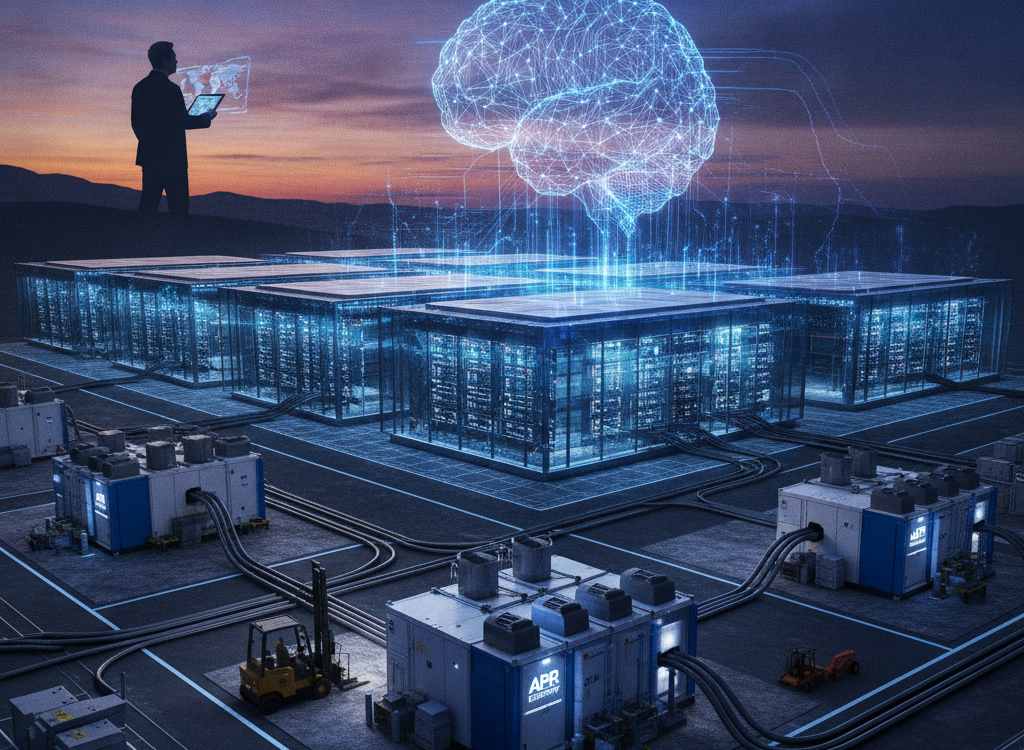
Elon Musk’s reported acquisition of APR Energy has quickly drawn attention far beyond the power sector. On the surface, it looks like a deal for a fleet of rapid-deploy generation assets. In reality, it may be a direct response to one of the biggest constraints facing artificial intelligence: access to reliable, scalable electricity.
If Musk is building the next generation of AI infrastructure, he is not just buying chips and data centers. He is buying time, flexibility, and control over the power needed to keep those systems running.
What APR Energy Does
APR Energy is known for providing rapid-deploy power solutions. That means mobile or modular generation assets that can be brought online faster than traditional utility-scale projects.
Its core appeal is speed. Instead of waiting years for transmission upgrades, interconnection approvals, or new large-scale plant construction, customers can add capacity relatively quickly. That makes APR especially relevant for industries that cannot afford to wait — including data centers, industrial operators, and emergency power users.
The company’s value proposition is simple:
- Fast deployment when grid access is limited
- Flexible capacity that can be moved or scaled
- Support for temporary or long-duration power needs
- A practical bridge between demand spikes and permanent infrastructure
For AI builders, that last point matters a lot.
Deal Details And What Is Known
Public details around the acquisition have been limited in the prompt, so the exact value, structure, timing, and any regulatory clearances should be treated carefully unless officially confirmed. What matters more than the headline price is the strategic logic behind the purchase.
If the transaction is now moving forward, it suggests Musk sees APR Energy not as a conventional utility asset, but as a tool for vertical integration. In other words, the goal may not simply be to own power generation — it may be to remove a major bottleneck for xAI’s infrastructure roadmap.
That is the key takeaway: this is less about buying a power company and more about buying optionality.
Why Musk Would Want APR Energy
The answer likely starts with xAI and its large-scale compute ambitions. AI models require huge clusters of GPUs, and those clusters require continuous, high-density electricity. As model sizes rise and inference workloads expand, power becomes one of the most important inputs in the entire AI stack.
That creates a problem for any company trying to scale quickly:
- Grid interconnection can take years
- Local utilities may not have spare capacity
- Transmission upgrades move slowly
- Permitting and environmental reviews can delay new supply
APR Energy offers a way around that bottleneck.
By owning rapid-deploy generation, Musk could potentially add power where and when it is needed, rather than waiting for the grid to catch up. That speed advantage is critical in AI, where being first to scale can shape market position, compute availability, and product rollout.
There is also a strategic control angle. A company that depends on outside utilities is exposed to price volatility, congestion, outages, and scheduling limits. A company that controls more of its own generation has more freedom to expand on its own timeline.
In AI, electricity is becoming as strategic as semiconductors.
Impact On The Energy Market
The broader implications could extend well beyond xAI.
Traditional Utilities And Grid Operators
If AI companies increasingly build or buy their own power solutions, utilities may face a new kind of customer behavior. Instead of waiting in line for grid capacity, large users may seek private alternatives.
That could pressure utilities to accelerate planning, upgrade infrastructure faster, and offer more flexible service models. It may also create tension if major loads bypass the grid rather than strengthen it.
Rise Of Modular Power For AI
APR Energy fits a growing trend: modular, on-demand power for high-growth digital infrastructure. This is especially attractive where speed matters more than long-term asset permanence.
For AI data centers, modular power can serve as:
- A bridge to permanent grid connection
- Backup capacity for resilience
- A fast-track solution for new campuses
- A way to keep expansion from stalling
Fuel Mix Implications
A deal like this could influence demand across several power sources:
- Natural gas: likely to remain central for flexible, dispatchable generation
- Diesel: useful in some emergency and short-duration setups, though less attractive for large-scale long-term use
- Renewables: still important, but intermittency and interconnection timing remain challenges for constant AI loads
- Battery storage: increasingly valuable as a balancing tool, though not yet a full substitute for firm generation at scale
The most realistic near-term model is not an all-renewables or all-gas system. It is a hybrid system built around speed, reliability, and load management.
Investment Opportunities And Risks
For investors, the move reinforces several themes:
- Growth in power infrastructure tied to AI demand
- Rising demand for distributed and modular generation
- More capital flowing into grid-adjacent assets
- New opportunities in storage, gas infrastructure, and private power development
But there are risks too:
- Regulatory scrutiny if private generation bypasses public infrastructure goals
- Fuel price exposure, especially for gas and diesel-linked assets
- Execution risk if rapid-deploy power proves harder to integrate at scale
- Public debate over emissions if AI expansion leans heavily on fossil-based generation
What It Means For xAI, Tesla, And The AI Industry
For xAI, the logic is straightforward: more power means more room to train models, serve users, and expand infrastructure without waiting on outside constraints. If APR Energy becomes part of that equation, xAI gains a practical advantage in speed and autonomy.
For Tesla, the signal is more indirect but still important. Tesla has long been tied to energy storage, grid solutions, and electrification. Musk controlling more of the power stack could create future overlap across batteries, generation, grid services, and AI infrastructure, even if the businesses remain separate.
For the wider AI industry, the message is unmistakable: power is now a competitive moat.
Companies that secure electricity faster, cheaper, and more reliably may scale faster than those that rely solely on public infrastructure. That could reshape where data centers are built, how they are financed, and which firms are able to grow at full speed.
Will the next AI leader be the one with the best model — or the one with the best power strategy? Can the grid keep up with the next wave of compute demand? And will more tech companies start owning their own generation assets to avoid being boxed in by infrastructure delays?
Musk’s APR Energy move, if fully realized, fits a familiar pattern: identify the bottleneck, control the bottleneck, then scale faster than everyone else. That is classic vertical integration — and in the AI era, it may be one of the most important plays in the market.
The bigger picture is simple. If this acquisition stands as reported, it is not just a power deal. It is a statement about the future of AI infrastructure, where electricity is no longer a background utility but a strategic asset.